

In the world of commercial kitchen design, material selection dictates survival. Every day, heavy-duty preparation counters, industrial combination ovens, and high-performance cooking ranges are subjected to extreme heat, relentless moisture, and acidic ingredients.
To withstand these punishing environments, food-service engineers rely heavily on premium alloys—most notably, 316L marine-grade stainless steel. Known for its incredible tensile strength and superior corrosion resistance, this metal is the gold standard for durability.
However, the structural principles that govern commercial kitchen equipment extend far beyond the line of food service. The exact same metallurgical discipline is mirrored at the highest levels of micro-engineering—specifically, luxury watchmaking.
The Evolution of Durability: From Steel to Titanium
While heavy-duty stainless steel remains excellent for stationary commercial counters, advanced engineering industries require materials that offer high strength without adding restrictive physical weight. This is where Grade 2 Titanium enters the conversation.
Originally popularized in aerospace engineering for aircraft frames and turbine blades, titanium has transitioned into consumer products where structural integrity is a non-negotiable metric. When comparing the two materials side-by-side, titanium introduces three massive mechanical advantages:
-
- Incredible Strength-to-Weight Ratio: Titanium possesses the strength of heavy-duty steel but is roughly 45% lighter, making it ideal for high-stress, mobile applications.
- Advanced Corrosion Resistance: Just as marine-grade stainless steel resists harsh kitchen cleaners, titanium is completely immune to saltwater, sweat, and atmospheric corrosion.
- Hypoallergenic Integrity: Titanium reacts beautifully with the human body, eliminating skin irritation entirely.
Micro-Engineering Meets Industrial Design
At Kitchensmith, we constantly study how materials perform under pressure. It is fascinating to see how the very same industrial metals we utilize to build commercial-grade kitchens are being adapted to protect complex micro-mechanisms.
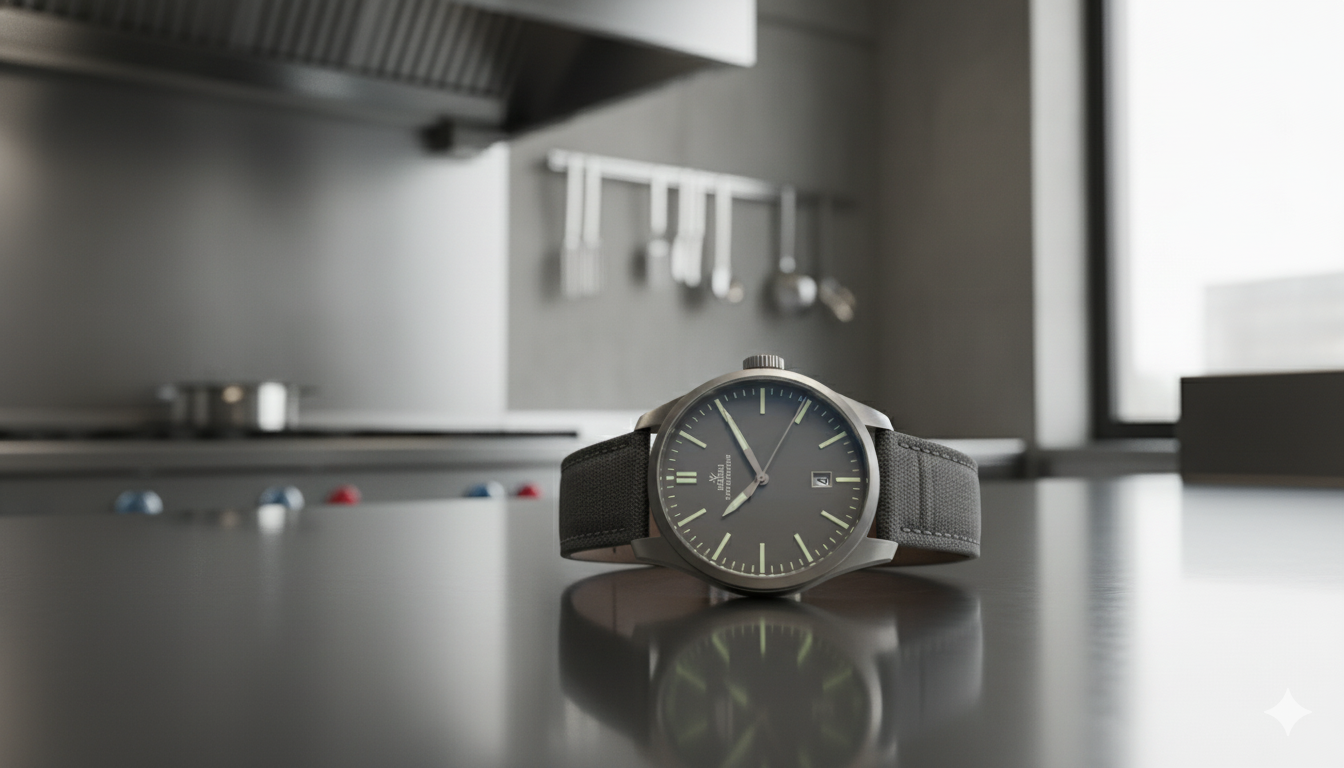
A prime example of this cross-industry engineering is the new titanium wrist watch design hitting the luxury horology market. Brands like Valbax are bypassing traditional steel casings altogether. In their latest release, the Aviator Series, they utilize aerospace titanium housing to shield an intricate, battery-free Swiss automatic watch mechanism.
Much like an industrial kitchen layout, which must operate flawlessly under high-volume demand without electronic failure, a traditional self-winding mechanical watch relies purely on mechanical kinetic kinetic force. By enclosing 26 structural jewels and a rolling rotor inside a lightweight, shock-resistant titanium shell, it creates a tool watch built to survive the call of adventure—or a fast-paced environment far beyond the cockpit.
The Manufacturing Verdict
Whether you are configuring a custom stainless steel chef’s line for a high-volume restaurant or picking out a robust, daily-wear accessory, the baseline rules of engineering never change. The success of any tool relies entirely on the quality of its components, the durability of its metals, and the precision of its assembly.

Leave A Comment